
Joy Foroughi
Executive Assistant


What Is Full-Stack Development? A 2026 Guide
Discover what is full-stack development in our 2026 guide. Learn how it streamlines building apps from frontend to backend. Start mastering it today!

TL;DR:
Full-stack development involves building both the frontend and backend of applications within a unified workflow. It covers all layers, from user interfaces to databases and APIs, making it highly versatile for startups and agile teams. To succeed, full-stack developers need a broad skill set that includes programming, API design, DevOps, and cloud infrastructure.
Full-stack development is defined as the end-to-end process of building both the frontend and backend of a web or mobile application within a single, unified workflow. A full-stack developer handles everything from HTML, CSS, and JavaScript on the client side to Node.js, Python, or Java on the server side, plus database management with SQL or MongoDB and API integration. This breadth makes full-stack development one of the most versatile approaches in modern software engineering. For startups and growing businesses, it means fewer handoffs, faster iteration, and a developer who understands how every layer of the product connects.
What is full-stack development, really?
Full-stack development covers the complete application lifecycle, from the pixels a user sees to the database queries running behind the scenes. The term "full-stack" refers to the entire technology stack required to build a functional application. That stack typically splits into three layers: the frontend (what users interact with), the backend (the server logic), and the data layer (databases and APIs).

Frontend technologies include HTML, CSS, JavaScript, and component libraries like React or Angular. The backend runs on environments like Node.js, Python with Django, or Java with Spring. Databases range from relational systems like PostgreSQL to document stores like MongoDB. A full-stack developer works across all three layers, which is why the role is sometimes called an "end-to-end developer" in engineering circles.
The full-stack role is distinct from software engineers who specialize in system architecture or algorithms. Full-stack developers specialize in web and mobile application lifecycle management. That focus makes them especially valuable in product-driven environments where speed and context matter more than narrow depth.
What does a full-stack developer do daily?
A full-stack developer's day is not evenly split. Daily work typically divides across UI/UX prototyping (10–20%), backend and database work (40–50%), and DevOps or testing tasks (30–40%). That breakdown shifts depending on the project phase, but backend and data work consistently dominate.
Here is a realistic picture of what a typical day looks like:
Morning standup and sprint planning. Full-stack developers participate in agile ceremonies, flagging blockers that span both frontend and backend. They are often the first to spot when a UI change will require an API update.
Frontend component work. Building or refining React or Vue components, connecting them to backend endpoints, and verifying that data renders correctly across devices.
Backend API development. Writing and testing REST or GraphQL endpoints, managing authentication, and handling server-side business logic.
Database queries and schema updates. Adjusting SQL schemas or MongoDB collections as product requirements evolve.
Testing and deployment. Running unit and integration tests, then pushing changes through a CI/CD pipeline using tools like GitHub Actions or Jenkins.
Full-stack developers also serve as a communication layer between frontend and backend specialists on larger teams. They can translate a designer's intent into a backend requirement without losing context. That cross-team fluency reduces miscommunication and speeds up delivery.
Pro Tip: If you are hiring a full-stack developer for a startup, prioritize candidates who have shipped a product end-to-end, not just those who list every framework on their resume. Shipping experience reveals judgment, not just syntax knowledge.
Full-stack vs. front-end vs. back-end: what is the difference?
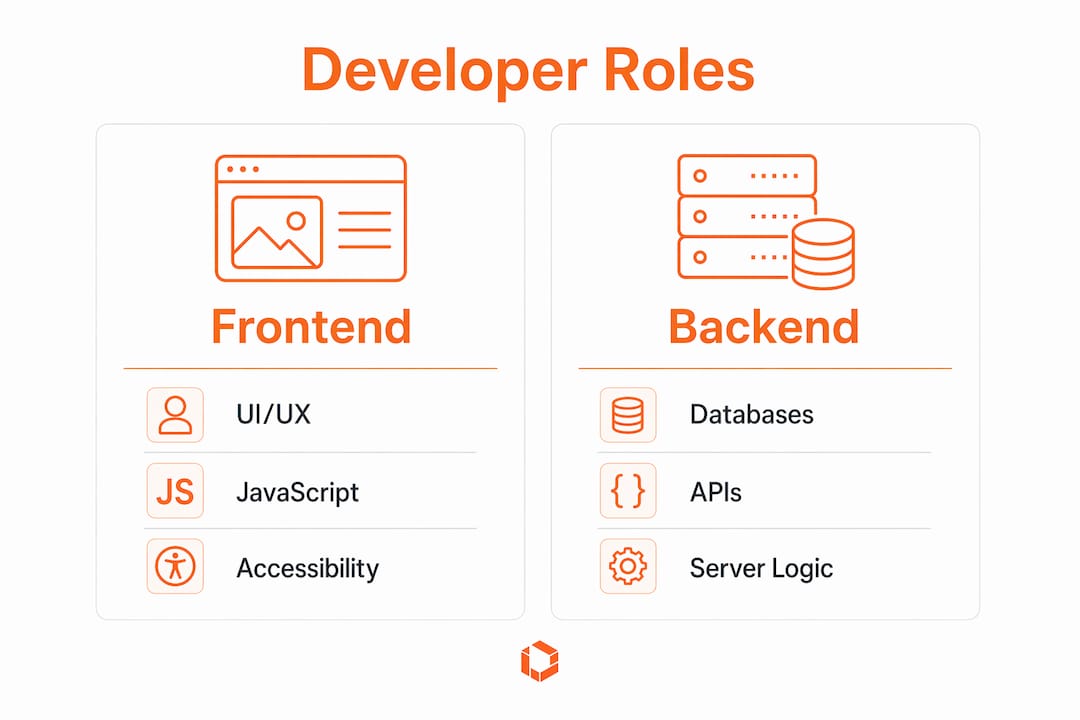
The three roles share overlapping skills but serve different purposes on a team. Understanding the distinction helps you hire the right talent or choose the right learning path.
Role | Primary Focus | Core Skills | Best For |
|---|---|---|---|
Frontend Developer | User interface and experience | HTML, CSS, JavaScript, React, Angular | Pixel-perfect UI, accessibility, performance |
Backend Developer | Server logic and data | Node.js, Python, Java, SQL, APIs | Scalability, security, data architecture |
Full-Stack Developer | End-to-end application | All of the above plus DevOps basics | Startups, MVPs, cross-functional teams |
Frontend developers go deep on user experience, animation, and accessibility. Backend developers focus on API design quality, database performance, and server security. Full-stack developers cover both, which makes them faster to deploy on small teams but potentially shallower than a specialist on any single layer.
The trade-off is real. A dedicated backend engineer will typically outperform a full-stack developer on complex distributed systems. A dedicated frontend engineer will produce more polished UI work. Full-stack development shines in early-stage products, MVPs, and teams where a developer needs to move across the codebase without waiting for a handoff.
For businesses, the practical question is scope. If you are building a complex financial platform with strict security requirements, you want specialists. If you are building a startup's first mobile app and need to move fast, a full-stack developer or a small full-stack team is the more efficient choice.
What technologies make up a modern full-stack?
The modern full-stack tech landscape has shifted significantly. jQuery and PHP are no longer the entry point. Today's full-stack developer works with component-based UI libraries, asynchronous backend environments, and cloud-native infrastructure. Here is how the stack breaks down in 2026:
Frontend:
React remains the dominant component library for web and React Native for mobile
Angular is preferred in enterprise environments for its opinionated structure
Vue.js offers a lighter alternative for teams that want flexibility without React's ecosystem overhead
Backend:
Node.js powers asynchronous, event-driven server logic and pairs naturally with JavaScript-heavy frontends
Python with Django or FastAPI is the go-to for data-heavy applications and machine learning integrations
Go is gaining traction for high-performance microservices
Databases and APIs:
PostgreSQL and MySQL for relational data with complex query requirements
MongoDB for document-based, flexible schemas common in content and user-data applications
REST and GraphQL for API design, with GraphQL growing in adoption for frontend-driven data fetching
DevOps and Infrastructure:
Docker and Kubernetes for containerization and orchestration
CI/CD pipelines via GitHub Actions, CircleCI, or Jenkins for automated testing and deployment
AWS, Google Cloud, or Azure for cloud hosting and managed services
Layer | Popular Tools in 2026 |
|---|---|
Frontend | React, Angular, Vue.js |
Backend | Node.js, Python/Django, Go |
Database | PostgreSQL, MongoDB, MySQL |
DevOps | Docker, Kubernetes, GitHub Actions |
Cloud | AWS, Google Cloud, Azure |
Many junior full-stack developers lack DevOps expertise such as CI/CD pipelines and container orchestration. That gap is a real risk in production environments where deployment and security are non-negotiable. If you are learning full-stack development, treat DevOps as a core skill, not an optional add-on.
Pro Tip: Use the Tech Stack Finder by Blueprint AI to map out the right technology combination for your specific app before you start building. Choosing the wrong stack early is expensive to reverse.
Benefits and challenges of full-stack development
Why businesses choose full-stack teams
The business case for full-stack development is straightforward. Businesses that use full-stack developers reduce cross-team coordination time by up to 30–40%, which directly improves project efficiency. That reduction matters most in early-stage startups where every sprint counts and budget is tight.
Key benefits include:
Faster product iteration. One developer can move a feature from database schema to UI without waiting on another team.
Lower initial headcount. A full-stack developer replaces two or three specialists in the MVP phase, reducing burn rate.
Holistic product perspective. Full-stack developers understand how a frontend change affects backend load, which leads to better architectural decisions.
Easier onboarding. A single developer who owns the full codebase is easier to brief than a fragmented team.
The real challenges you should not ignore
Full-stack development is not without trade-offs. The breadth required creates genuine risks:
Depth limitations. A full-stack developer will rarely match a specialist's depth in any single layer. For complex security or performance requirements, that gap matters.
Burnout risk. Attempting to master every layer equally leads to burnout and technical debt. The sustainable approach is a T-shaped skillset: deep expertise in one area and functional knowledge of the rest.
Continuous upskilling pressure. The stack changes fast. A developer who was current in 2023 may be behind on cloud-native patterns by 2026.
"Startup hiring managers prioritize product focus more than technical perfection, valuing understanding 'why' over memorizing many frameworks." — Pearl Talent
On the career side, full-stack development offers strong earning potential. Salaries scale significantly with experience and geography. In the U.S. market, mid-level full-stack developers command competitive compensation, and the role consistently ranks among the most in-demand in engineering hiring. For motivated learners, proficiency in 3 months is achievable with a structured roadmap, though production-ready confidence typically takes longer to build.
Key takeaways
Full-stack development is the most efficient approach for startups and product teams that need end-to-end ownership, fast iteration, and architectural clarity across the entire application.
Point | Details |
|---|---|
Full-stack covers all layers | Frontend, backend, database, and DevOps are all within a full-stack developer's scope. |
T-shaped skills prevent burnout | Deep expertise in one area plus broad functional knowledge is the sustainable model. |
DevOps is non-negotiable | CI/CD, Docker, and cloud infrastructure are core skills, not optional extras. |
API design drives scalability | Poor API contracts create technical debt that slows growth and complicates onboarding. |
Full-stack suits startups best | Early-stage teams benefit most from the speed and cost efficiency full-stack developers provide. |
The uncomfortable truth about full-stack in 2026
I have worked with enough startups and development teams to say this plainly: most teams misuse the full-stack label. They hire one developer, call them "full-stack," and expect specialist-level output across every layer simultaneously. That expectation is the fastest way to burn out a good engineer and ship a fragile product.
The full-stack developer's true value is architectural perspective. They understand how a frontend change ripples into backend load and database performance. That judgment is rare and genuinely valuable. But it only shows up when the developer has the space to think, not when they are context-switching between five layers under deadline pressure.
What I tell every startup founder who asks: hire a full-stack developer to own the product vision and move fast in the early stages. But plan to bring in specialists as the product scales. A full-stack developer who has shipped your MVP is also your best guide for knowing exactly where you need to deepen the team.
The other thing most articles skip: API design is where full-stack projects succeed or fail. A developer who writes clean, well-documented API contracts from day one saves the team months of refactoring later. Prioritize that skill above framework knowledge every time. You can learn a new framework in weeks. Fixing a poorly designed API in production takes quarters.
For teams exploring backend architecture patterns before committing to a stack, that research investment pays off significantly at scale.
— Cyrus
How TouchZen media builds full-stack products that scale
TouchZen Media specializes in end-to-end mobile and web application development for startups and growing companies across iOS, Android, and web platforms. Whether you need a full-stack team to build your MVP from scratch or senior developers to fill specific gaps in your existing stack, TouchZen Media brings the architectural depth and product focus that early-stage teams need most.
TouchZen Media's mobile app development services cover the full product lifecycle, from UI/UX design and backend architecture to deployment and ongoing support. For teams that need to scale quickly without a full-time hire, the staff augmentation program places senior full-stack developers directly into your workflow. If you are building something and need a team that communicates clearly and ships reliably, explore what TouchZen Media delivers for startups in California and beyond.
FAQ
What is full-stack development in simple terms?
Full-stack development is the practice of building both the user-facing frontend and the server-side backend of an application. A full-stack developer manages the entire product, from what users see to how data is stored and processed.
How long does it take to become a full-stack developer?
Motivated learners can reach basic proficiency in approximately 3 months with a structured program. Production-ready confidence, including DevOps and API design skills, typically takes 12–18 months of hands-on experience.
What is the difference between full-stack and back-end development?
Back-end development focuses exclusively on server logic, databases, and APIs. Full-stack development includes all of that plus frontend work, making it a broader role suited to end-to-end product ownership.
Is full-stack development a good career in 2026?
Full-stack development remains one of the most in-demand engineering roles in 2026. The combination of frontend, backend, and DevOps skills commands strong salaries and provides flexibility across industries and company sizes.
What technologies should a full-stack developer know?
A full-stack developer in 2026 should know React or Angular for the frontend, Node.js or Python for the backend, PostgreSQL or MongoDB for databases, and Docker plus a CI/CD tool for deployment. Cloud platform basics on AWS or Google Cloud are also expected in most production environments.