
Joy Foroughi
Executive Assistant


PT Practice Owners: Use an App to Boost Adherence, Capture RTM Revenue
Patient-facing apps can help physical therapy practices improve home-exercise engagement, streamline communication, and support more consistent follow-up. Their value depends on clinical workflow, patient adoption, and appropriate privacy and security safeguards. When an app vendor creates, receives, maintains, or transmits protected health information (PHI) on behalf of a practice, the relationship may require a business associate agreement (BAA) as part of a broader HIPAA compliance program.

atient-facing apps can help physical therapy practices improve home-exercise engagement, streamline communication, and support more consistent follow-up. Their value depends on clinical workflow, patient adoption, and appropriate privacy and security safeguards. When an app vendor creates, receives, maintains, or transmits protected health information (PHI) on behalf of a practice, the relationship may require a business associate agreement (BAA) as part of a broader HIPAA compliance program. What follows covers the features, the evidence, the real costs, and how to choose a build path that fits a practice of your size.
TL;DR:
Personalized video exercises recorded by therapists significantly improve patient confidence and adherence, leading to better home exercise performance and fewer errors.
Building an app focused on core features like video HEP, secure messaging, and adherence dashboards is more effective than attempting to include every possible function from the start.
Integrating the app with the existing EHR via APIs or HL7 can reduce duplicate data entry while keeping the EHR as the practice's primary record system.
Cost considerations depend on choosing between a white-label subscription with limited control or a custom build offering full branding and workflow customization.
The app should never replace clinical judgment, and success depends on how clinicians introduce and use it within their established workflows.
Why Your Physical Therapy Practice Needs an App and What It Should Do for Patient Outcomes
The clearest evidence comes from a systematic review with meta-analysis published in JMIR, which found that apps delivering personalized video exercises produced meaningful gains in physical function and, even more notably, in patients' confidence performing exercises correctly on their own. The effect on confidence was larger than the effect on raw function scores. That distinction matters for a PT practice because confidence is often what determines whether a patient keeps doing a home exercise program (HEP) after week three, when motivation typically drops off. The review's authors were candid that the underlying evidence quality was low and called for larger, more rigorous trials, so this is a real but still-developing signal, not a guarantee.
What does that gain look like inside a clinic? A patient who can watch their own therapist demonstrate a modified lunge, rather than working from a static printed handout, is less likely to perform it wrong and reinjure the area. Fewer errors mean fewer emergency call-ins asking "is this normal soreness or did I hurt myself?" Those calls consume front-desk and clinician time that a well-designed app absorbs through short video check-ins or a quick photo upload instead.
Better adherence can support continuity of care and may reduce avoidable administrative effort, but it should never be framed as a promise of additional billable visits. Research on mobile care delivery found that synchronous video visits and timely, direct messaging strengthen the patient-provider relationship in ways tied to better engagement and clinically meaningful outcomes. The mechanism is practical: patients who feel supported and connected to their care team may be more likely to stay engaged between visits.
On the operations side, the wins compound:
Fewer reactive phone calls. Secure messaging routes questions to the right staff member instead of interrupting a session in progress.
Better triage before visits. A clinician who can see adherence data and pain scores before a patient walks in spends less time re-asking the same intake questions.
Data-driven follow-ups. Instead of guessing who's falling behind, staff can pull a list of patients with three missed check-ins and intervene early.
Referral and branding leverage. A clinic-owned app with the practice's name on the home screen keeps the brand in front of patients daily, unlike a generic patient portal bookmark that gets forgotten.
That last point is easy to underestimate. A branded app functions as a small, constant advertisement sitting on a patient's phone, visible every time they open it to log a session, long after physicians' referral letters have been filed away.
Quick reference: the JMIR meta-analysis reported a standardized mean difference of 0.35 for physical function and 0.67 for exercise confidence among apps using personalized video content, evidence graded low quality but directionally consistent across studies.
Core Features Every Effective PT App Should Include
Not every feature carries equal weight, and a practice that tries to build everything at once usually ships nothing on time. Here's the priority order, ranked by clinical necessity and typical build complexity.
Personalized video home exercise programs. This is the feature with the strongest evidence behind it. Consider supporting clinician-recorded video as well as a carefully selected exercise library, so patients can receive instructions tailored to their program and understand how each movement applies to their recovery.
Secure messaging designed for HIPAA-regulated workflows. A vendor or agency that creates, receives, maintains, or transmits protected health information on behalf of a practice may need to enter into a business associate agreement before patient data is handled. A BAA is one part of a broader privacy and security program, not a stand-alone compliance guarantee.
Adherence dashboards clinicians actually use. A dashboard nobody checks before a visit is wasted engineering. The goal is a five-second glance: who's on track, who's fallen off, who needs a nudge.
Patient-reported outcome measures (PROMs) with documentation integration. Standardized questionnaires, capturing pain, function, and quality-of-life scores, need to feed into clinical notes without manual re-entry.
Telehealth video visits plus asynchronous check-ins. Live video covers scheduled follow-ups; asynchronous check-ins (a photo, a short video, a quick pain scale) cover everything between visits without requiring both parties online at once.
Reminders and nudges with a simple interface. Push notifications work, but only if the interface underneath is forgiving. A large share of orthopedic and post-surgical patients are older adults who did not grow up with apps, so font size, contrast, and a minimum number of taps to log an exercise all matter more than they would in a consumer fitness app.
Export and reporting features that can support Remote Therapeutic Monitoring (RTM) workflows. If RTM is part of the practice's model, reporting should make it easier to review relevant information and maintain documentation. Confirm current payer and coding requirements before treating any product capability as billable.
Research backs several of these priorities directly. Findings from qualitative work on mobile applications supporting home exercise prescription show that patients accept an app most readily when it's easy to navigate, clearly tied to their recovery, and introduced by the therapist rather than left as a self-download link in a discharge packet. That's a workflow lesson as much as a design one: even the best-built app underperforms if front-desk staff hand patients a QR code with no explanation.
Adherence tools deserve a second look, because the difference between apps that get used and apps that get deleted often comes down to how the reminder and progress-visualization system is built. Guidance on must-have features for practitioner-facing PT apps points to reminder cadence and visual progress tracking as two of the highest-leverage, lowest-cost features a practice can prioritize.
Pro Tip: Don't build every feature on this list in version one. Launch with video HEP, secure messaging, and adherence tracking. Add PROMs and RTM export in a second phase once you've confirmed patients actually open the app weekly.
Telehealth deserves a caveat that applies equally to in-clinic care: any remote exercise modification or new program assignment should happen under the same clinical judgment a therapist would apply in person, not as an automated suggestion the app generates on its own.
What the Research Actually Says About App-Based Rehab
The honest summary of the evidence is "promising but not settled." The JMIR systematic review with meta-analysis found statistically meaningful improvements in physical function and, more strongly, in patients' confidence performing prescribed exercises when apps delivered personalized video content. That's the strongest single data point supporting app investment for a PT practice, and it's worth repeating to referring physicians and patients alike.
The caveat that comes with it matters just as much as the finding: the review's authors graded the overall evidence quality as low, driven by small sample sizes, short follow-up periods, and inconsistent outcome measures across the studies included. Translation for a practice owner: expect the app to help, but don't market it as a clinically proven replacement for hands-on care, because the research doesn't support that claim yet.
Observational and qualitative research fills in the "why" behind the numbers. A separate look at physical therapist and patient perspectives on mobile technology for home exercise prescription in arthritis care found that apps let therapists extend rehabilitation support without proportionally increasing their own workload, largely by automating the delivery of exercise instructions and educational content. Clinician oversight remained necessary for program adaptation and for holding patients accountable, meaning the app was never treated as a hands-off substitute for the therapist's judgment.
A few threads run consistently through this research:
Personalized, therapist-recorded video outperforms generic exercise libraries on both function and confidence outcomes.
Patient acceptance hinges on usability and clear clinical relevance, not on flashy design.
Apps introduced by the therapist directly, during the visit, see meaningfully better uptake than apps handed off via a discharge sheet.
None of the research supports removing clinician oversight from the equation, even when the technology performs well.
The practical takeaway for an owner or manager: apps work best as an extension of the clinical relationship, not a replacement for it. Professional guidance from the APTA on digital health reinforces this, recommending digital tools be integrated into practice to improve access and engagement specifically when used appropriately within existing clinical workflows, not as a standalone product bolted onto the side of care.
What an App Actually Costs and What It Returns
Cost ranges swing widely depending on one decision made early: custom build versus white-label subscription. A white-label HEP platform typically runs on a monthly per-clinician or per-patient subscription model, with lower upfront cost but limited branding control and feature flexibility. A custom-branded app costs more upfront, usually funded as a project engagement covering discovery, design, and engineering, but gives the practice full control over workflow, branding, and future feature additions without waiting on a vendor's product roadmap.
Several cost drivers apply regardless of path:
Video production. Recording a clinician's own exercise demonstrations, rather than licensing stock footage, takes real time but is the single feature most tied to the evidence on patient confidence gains.
Integration work. Connecting the app to an existing EHR via API or HL7 adds engineering cost but avoids duplicate data entry for staff.
Security and compliance build-out. Encryption, access controls, and audit logging aren't optional line items when protected health information is involved.
Ongoing support and maintenance. Apps need updates for operating system changes, bug fixes, and feature iteration well past launch day.
Remote Therapeutic Monitoring (RTM) may be relevant for some PT practices, but it should not be treated as automatic app revenue or a guaranteed return on investment. Eligibility and documentation depend on the service delivered, the data collected, payer policies, and current coding rules. A practice should confirm applicable requirements and time thresholds with a qualified billing compliance advisor or certified coder before forecasting RTM revenue or selecting a platform around a specific billing use case.
A practical way to frame ROI is to evaluate the full operational picture: patient engagement, staff time spent on manual follow-ups and rescheduling, clinician workflow, and the cost of the chosen platform or build. Any financial impact will vary by practice and should be measured against defined outcomes during a pilot rather than assumed before launch.
A realistic pilot rollout looks like this:
Weeks 1–2: Workflow and compliance planning. Map the patient journey, clinician workflow, data requirements, and privacy safeguards before development or configuration begins.
Weeks 3–6: Core experience. Build or configure the essentials: video HEP, secure communication, and adherence tracking.
Weeks 7–10: Controlled pilot. Test the workflow with one provider group, gather patient and clinician feedback, and resolve adoption or operational gaps.
After the pilot: Measured expansion. Add clinicians, integrations, PROMs, or RTM-supporting functionality based on demonstrated patient use and staff readiness.
That timeline compresses or stretches depending on scope, but a pilot with a single provider group before a full-clinic rollout catches workflow problems while the stakes are still small.
Keeping Your EHR as the System of Record
The biggest implementation mistake a practice can make is treating the app as a reason to replace the electronic health record. Don't. The chart stays the legal system of record; the app is an engagement layer that feeds data into it, not a competitor to it.
Integrate, don't replace. Connecting the app to the existing EHR through an API or HL7 interface lets adherence summaries and PROM results write back into the patient chart automatically, so clinicians aren't toggling between two systems mid-visit. Industry guidance on adding HEP and RTM tools to multi-clinic EHR environments consistently recommends this layered approach over a full EMR swap, since replacing an EMR carries high hidden costs and operational disruption that rarely pay off compared to adding a focused engagement tool on top.
Define what clinicians need before the visit starts. At minimum, that's an adherence flag (on track, falling behind, no data) and a one-line PROM summary. Anything more detailed than that gets skimmed past, not read.
Assign clear staff roles. Someone needs to own program assignment (usually the treating clinician), someone needs to monitor the adherence dashboard between visits (often a PT assistant or care coordinator), and someone needs authority to escalate a concerning message (a supervising clinician, always).
Choose the lowest-disruption integration your team can execute. For a small clinic, that might mean a manual weekly export rather than a live API connection in the first few months, upgrading automation once the workflow itself is proven.
Pro Tip: Assign one staff member as the "adherence lead" for the first ninety days after launch. Someone needs explicit ownership of reviewing flagged patients daily, or the dashboard becomes another unread inbox.
Custom App or Off-the-Shelf Platform: How to Decide
The right path depends on three variables: clinic size, budget, and how much your workflow deviates from a generic template.
A single-location practice with one to five providers and a tight budget usually gets more value from a focused, white-label HEP platform that handles video assignment and basic messaging without a large upfront investment. The tradeoff is limited branding and less control over feature priorities, since you're working inside someone else's product roadmap.
A multi-location practice, or one with a distinct clinical niche, like sports performance, pelvic health, or pediatric care, benefits more from a custom-branded build once patient volume justifies the cost. Custom development lets the app match your specific intake workflow, your branding, and your exact PROM instruments instead of forcing your process to match a generic template.
Before signing with any vendor or development agency, ask these questions directly:
Will you sign a business associate agreement before any patient data is shared with your platform?
What security certifications or audits has your infrastructure passed?
What integration method connects to our existing EHR, API, HL7, or manual export?
What is your support service level agreement after launch, and what does ongoing maintenance cost?
Who owns the code and the data if we switch vendors later?
Escalate to a custom build once a white-label platform starts limiting growth: when you're paying for features you don't use, when branding restrictions hurt patient recognition, or when your clinical workflow requires something the vendor's roadmap doesn't include this year.
How an Agency Engagement Typically Works
A senior-team development engagement generally moves through five stages: discovery, prototype, HIPAA-compliant build, launch, and ongoing maintenance.
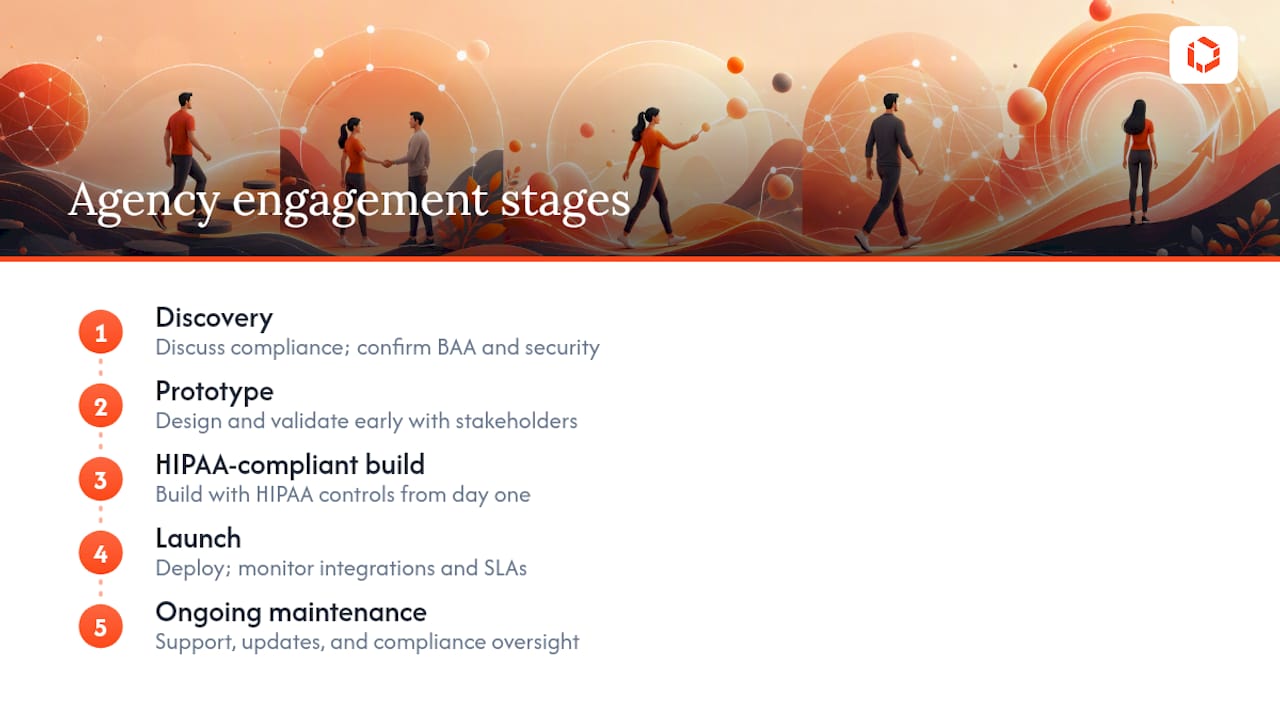
Discovery should include a direct conversation about compliance requirements, not just feature wish lists. A properly scoped project confirms the business associate agreement, data residency expectations, and security certifications before a single line of code gets written, because retrofitting compliance after launch is far more expensive than building it in from day one.
Ask any agency you're evaluating the same questions listed in the build-versus-buy section above: BAA status, security certifications, integration approach, and support SLA terms. A practice that can't get straight answers to those five questions before signing a contract should keep looking.
One structural advantage worth naming directly: working with senior developers and designers from kickoff through launch, rather than having a project handed off to junior staff partway through, tends to shorten timelines and reduce the rework that comes from miscommunication between account managers and engineers. For a compliance-sensitive build like a PT app, fewer handoffs means fewer chances for a HIPAA requirement to get lost in translation.
Why Most Practices Get the App Decision Backward
A common mistake is starting with features instead of the clinical relationship the app is supposed to extend. Owners ask "what should the app do?" before asking "how will my clinicians introduce this to patients?" The research is fairly clear on this point: adoption depends heavily on whether the therapist introduces the app personally and explains why it matters, not simply on how many features the build includes.
The conventional advice, build a full-featured platform, then train staff, gets the sequence backward. Train your clinicians on the introduction script first. Launch with three features that support that conversation: video HEP, messaging, and adherence tracking. Everything else, PROMs, RTM export, telehealth, is worth adding once you've confirmed patients actually open the app in week two, not just week one.
The overrated piece of this whole conversation is design polish. Patients tolerate a plain interface far more than clinicians expect, as long as the content inside it is theirs, recorded by their own therapist, not a stock library. Spend the early budget on video content and clinical workflow fit before spending it on visual refinement.
Building a Compliant, Patient-Focused App Without the Guesswork
Choosing between a white-label subscription and a custom build comes down to how much control your practice needs over branding, integration, and future features, and that's exactly where a senior-led development partner earns its cost. A senior-led development partner works directly with founders and practice owners from discovery through launch, avoiding layers of junior staff, which matters most on a HIPAA-sensitive build where a missed compliance detail costs far more to fix after launch than before it.
Before reaching out to any development partner, get three things ready: a rough patient volume estimate, a list of your must-have features versus nice-to-haves, and confirmation of which EHR system the app needs to integrate with. That preparation alone will shorten your discovery call and get you a more accurate cost estimate.
If your practice is ready to scope a custom-branded, clinician-focused app, start with a conversation about custom mobile app development built around your workflow, not a generic template.
This article is provided for general informational purposes only and is not legal, billing, compliance, or clinical advice. Consult qualified legal, billing, privacy, and clinical professionals before making decisions for your practice.
Sources
FAQ
What apps do physical therapists use?
Most practices use either a dedicated HEP and RTM platform built for clinical use or a custom-branded app connected to their EHR; general consumer fitness apps lack the clinical documentation and PROM integration a practice needs.
What are the benefits of using a therapy app?
The clearest documented benefits are improved physical function and exercise confidence from personalized video content, along with operational gains like reduced phone-based admin work and better pre-visit patient triage.
What is the average cost of a therapy app?
Costs vary widely between a white-label monthly subscription platform and a fully custom build, with drivers including video production, EHR integration, and ongoing support; a practice should request a scoped estimate from a development partner based on its specific feature list rather than relying on a generic figure.
Is a physical therapy app HIPAA compliant by default?
No app is HIPAA-compliant automatically; compliance depends on the platform's security architecture and requires a signed business associate agreement with any vendor or developer handling patient data.