Joy Foroughi
Executive Assistant


Why Startups Need Custom Software to Scale in 2026
Discover why startups need custom software in 2026 to overcome growth barriers. Unlock efficiency, streamline processes, and enhance customer satisfaction.

TL;DR:
Startups need custom software when off-the-shelf tools create workflow mismatches, manual processes, and unreliable data. Building tailored solutions around core differentiators offers strategic advantages such as better alignment, trust in data, and cost control. Early adoption of custom software, supported by AI automation, can prevent costly migrations and strengthen competitive positioning.
Custom software is purpose-built around a startup's unique operations, customer journeys, and business rules, unlike generic tools that force you to reshape your processes to fit someone else's product. This distinction is why startups need custom software at a certain stage of growth: off-the-shelf platforms like HubSpot, Shopify, and Stripe are excellent starting points, but they eventually hit a wall when your pricing logic, onboarding flow, or approval workflows don't match their assumptions. The result is a patchwork of workarounds, manual data entry, and unreliable reporting that slows your team and frustrates your customers. Understanding where that wall sits, and what to do when you hit it, is one of the most consequential decisions a founder makes.
Why startups need custom software: the core argument
Custom software, also called bespoke application development, is defined by fit. Fit, not code, is the primary strategic advantage. It prevents teams from wasting hours on workarounds and misaligned workflows that generic platforms create by design.
Most startups begin with off-the-shelf tools because the economics make sense early on. Stripe handles payments. HubSpot manages leads. Notion tracks projects. But as your product matures, these tools start to conflict with each other and with your actual business model. Your CRM defines a "customer" one way; your billing platform defines it another. Your checkout logic requires conditional pricing that no standard e-commerce plugin supports. You end up with three people manually reconciling spreadsheets every Monday morning.
This is not a scaling problem. It is a fit problem. And custom software solves it by building the system around your business, not the other way around.

What problems do startups face with off-the-shelf software?
Generic software creates predictable failure points, and most founders encounter them in the same order. Here are the four most common breakpoints:
Onboarding flows that don't match your customer journey. Standard CRMs assume linear sales pipelines. If your product has a freemium model, a multi-stakeholder approval process, or a usage-based pricing tier, most CRMs cannot represent that journey without expensive customization or manual intervention.
Checkout and pricing logic that generic tools can't support. Platforms like Shopify handle standard product catalogs well. The moment you introduce dynamic pricing, subscription bundles, or B2B invoicing rules, you are writing workarounds or paying for middleware that adds latency and failure points.
Manual data copying between disconnected systems. Manual data reconciliation is one of the most expensive failure modes in a multi-tool stack. When your CRM, billing platform, and analytics tool each define "order" differently, your reports become unreliable and your team spends hours reconciling data instead of building the business.
Reporting that no one trusts. When different systems define the same entity differently, such as a customer or a completed transaction, leadership loses confidence in dashboards. Decisions get made on gut feel instead of data.
Pro Tip: Before investing in custom development, audit your team's weekly workflows for any task that involves copying data between two tools. Each one is a hidden cost and a signal that your current stack has a fit problem.
The cumulative effect of these breakpoints is significant. Your team works around the software instead of through it. Customer experience suffers because your internal processes are fragmented. And as you grow, the cost of these workarounds scales faster than your revenue.
What are the key benefits of custom software for startups?
The benefits of custom software are not just operational. They are strategic. Here is what you actually gain when you build for fit:
Workflow alignment. Custom software integrates payments, CRM, and analytics via APIs, creating a single source of truth and eliminating the manual processes that drain productivity. Your team moves faster because the system reflects how you actually work.
Better customer experience. When your internal systems are coherent, your customer-facing product is coherent. Onboarding flows match your actual user journey. Pricing is presented correctly the first time. Support teams have complete context without switching tabs.
Data you can trust. A tailored data model means every system agrees on what a "customer" or "order" means. This makes your analytics reliable and your product decisions defensible.
Automation that compounds. JustPaid, a fintech startup, deployed a seven-agent autonomous engineering team and shipped 10 major features in one month. A single developer would have taken over ten months to achieve the same output. That is not just a productivity gain. It is a structural advantage over competitors still relying on generic tools and manual processes.
Cost control at scale. A company paying $2,500 per month across SaaS platforms spends $150,000 over five years before accounting for lost employee productivity. Custom software costs stabilize as the business scales because you are paying for infrastructure, not per-seat licenses that grow with every hire.
The importance of tailored software becomes clearest when you model out a three-year cost projection. SaaS fees compound. Custom software amortizes.
Custom software vs. off-the-shelf tools: cost, scalability, and flexibility
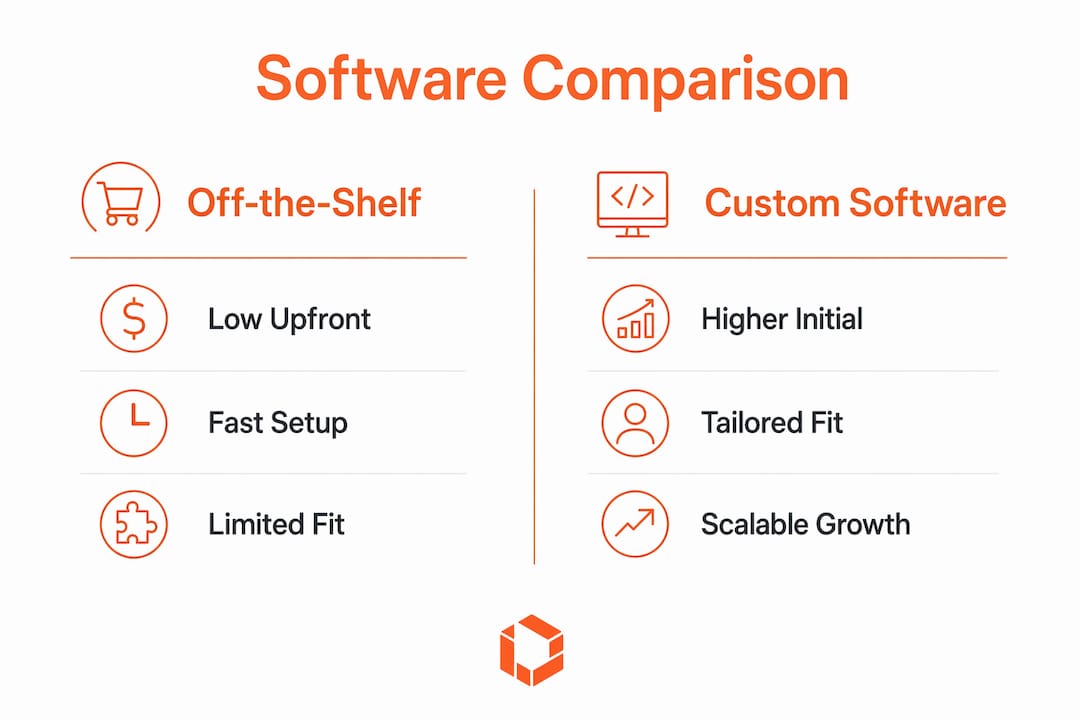
This is the comparison most founders want but rarely get in honest terms. Here is a direct breakdown:
Factor | Off-the-shelf tools | Custom software |
|---|---|---|
Upfront cost | Low (monthly subscription) | Higher (development investment) |
5-year total cost | High (seat fees compound with growth) | Lower (infrastructure scales, not licenses) |
Scalability | Limited by vendor roadmap and pricing tiers | Scales with your architecture decisions |
Flexibility | Constrained by vendor feature set | Built to your exact business rules |
Integration complexity | Middleware required; failure points multiply | Native integrations; single data model |
Time to deploy | Fast (days to weeks) | Longer (weeks to months) |
Off-the-shelf tools win on speed and initial cost. Custom software wins on long-term economics and operational fit. The decision is not binary. The smartest approach is to use proven SaaS tools for standard business functions like email, payroll, and basic CRM, and build custom only where proprietary value exists.
Pro Tip: Map your core differentiators before scoping any custom development. If a generic tool handles a workflow that is not unique to your business model, buy it. Build only where your competitive advantage lives.
The hidden costs of off-the-shelf tools are rarely visible in a budget spreadsheet. They show up as engineer hours spent on workarounds, customer churn from broken onboarding, and leadership decisions made on bad data. These costs are real, and they grow with the business.
How should founders evaluate and implement custom software solutions?
Moving from generic tools to custom software solutions for startups requires a structured approach. Here is a practical sequence that reduces risk and maximizes return:
Audit your current stack for fit failures. List every workflow that requires manual data transfer, every report your team questions, and every customer complaint tied to a process limitation. These are your build candidates.
Identify your strategic differentiators. What does your product do that no off-the-shelf tool can replicate? Your pricing model, your onboarding logic, your data relationships. These are the areas where custom development creates a moat.
Map your integration requirements. Custom software does not replace your entire stack. It connects it. Identify which systems, whether Stripe, Salesforce, or a proprietary data source, need to share a unified data model. This scoping work determines your development complexity and timeline.
Leverage AI and automation to accelerate delivery. AI-enabled development tools accelerate application design, testing, and iteration, freeing developers to focus on business problems rather than repetitive coding tasks. JustPaid's approach, using autonomous coding agents to run parallel workstreams, compressed ten months of engineering output into one. This model is now accessible to startups with modest engineering budgets.
Set milestones around business outcomes, not features. Define success as "onboarding completion rate improves by X%" or "manual reconciliation hours drop to zero," not "feature Y is shipped." Outcome-based milestones keep development aligned with business value.
Plan for iteration from day one. Custom software is not a one-time build. It evolves with your business. Budget for quarterly iteration cycles and treat your software as a product, not a project. You can explore scalability planning frameworks specifically designed for startup founders to structure this thinking.
How startups can leverage custom software most effectively comes down to this: build narrow, build deep, and build where your business is genuinely different from every other company using the same SaaS stack.
Key takeaways
Custom software delivers its greatest value when built precisely around the workflows and data models that define a startup's competitive advantage, not as a replacement for every tool in the stack.
Point | Details |
|---|---|
Fit drives value | Custom software aligns with your business rules, eliminating costly workarounds and unreliable reporting. |
SaaS costs compound | A $2,500/month SaaS spend reaches $150,000 over five years, before accounting for lost productivity. |
Build where you differ | Use off-the-shelf tools for standard functions; build custom only where proprietary value exists. |
AI accelerates delivery | Autonomous agent teams like JustPaid's can compress ten months of engineering output into one month. |
Audit before you build | Map fit failures in your current stack before scoping any custom development investment. |
Why I think most founders build custom software too late
The pattern I see most often is not founders who build custom software prematurely. It is founders who wait two years too long, accumulate a stack of six disconnected SaaS tools, and then face a six-figure migration project instead of a focused build.
The mistake is treating custom software as a luxury for later, something you earn after product-market fit. But the fit problem often causes the product-market fit problem. When your onboarding is broken because your CRM cannot represent your customer journey, you attribute churn to the product. The real culprit is the software stack.
What I have found works is a narrow, deliberate approach: buy everything generic, build only the one or two workflows that are genuinely proprietary to your business model. That is where custom software creates a moat. That is where the AI-assisted development conversation gets interesting, because the cost of building that narrow layer has dropped significantly.
The future of custom application development is not slower or more expensive than SaaS. With AI-powered tooling and agile practices, it is often faster to build a precise solution than to configure a generic one to approximate your needs. Founders who recognize this early will have a structural advantage over those still wrestling with spreadsheet reconciliation in year three.
Invest in fit. It pays compounding returns.
— Cyrus
Build your startup's competitive edge with TouchZen Media
If your current stack is generating workarounds instead of results, it may be time to build for fit rather than settle for approximation.
TouchZen Media is a specialized digital agency based in Orange County, California, with deep expertise in custom iOS and Android development for startups and growing companies. From strategic consulting and user-centric design to native app development and ongoing iteration support, TouchZen Media works directly with founders to build software that matches their actual business model. If you need to extend your engineering capacity without the overhead of full-time hires, TouchZen Media's staff augmentation services give you senior developers on demand. Ready to scope your build? Connect with the team for a personalized consultation.
FAQ
What is custom software development for startups?
Custom software development is the process of building applications specifically designed around a startup's unique workflows, data models, and business rules, rather than adapting generic tools to approximate those needs. It is also called bespoke application development and is most valuable when a startup's competitive advantage depends on processes that off-the-shelf platforms cannot support.
When should a startup invest in custom software vs. off-the-shelf tools?
Startups should invest in custom software when their core differentiators, such as pricing logic, onboarding flows, or data relationships, cannot be replicated by standard SaaS tools without expensive workarounds. For standard business functions like email, payroll, or basic CRM, proven off-the-shelf tools remain the more cost-effective choice.
How much does custom software cost compared to SaaS tools?
The upfront cost of custom software is higher, but a company spending $2,500 per month on SaaS platforms accumulates $150,000 in fees over five years before accounting for lost productivity. Custom software costs stabilize as the business scales because pricing is based on infrastructure, not per-seat licenses.
Can AI reduce the cost and time of custom software development?
Yes. AI-enabled development tools and autonomous coding agents significantly compress delivery timelines. JustPaid's engineering team shipped 10 major product features in one month using autonomous agents, compared to over one month per feature for a single developer, demonstrating that AI-assisted custom development is now accessible to startups with lean engineering budgets.
What are the biggest risks of relying on off-the-shelf software as a startup scales?
The primary risks are unreliable reporting from mismatched data definitions, manual reconciliation costs, and SaaS pricing that scales with headcount rather than efficiency. These issues compound as the business grows, making the eventual migration to custom software more expensive and disruptive than an earlier, targeted build would have been.