

Joy Foroughi
Executive Assistant


How to Get Your Mobile App Featured by Apple or Google: A Founder's Guide
How to get featured on App Store or Google Play. A founder's guide to building an app that earns editorial attention without false promises. Getting featured by Apple or Google is one of the most valuable moments in a mobile app launch. It is also never guaranteed. Here is what founders can actually control and how to build an app worth featuring.
Introduction
Being featured by Apple or Google is one of the most powerful things that can happen to a mobile app. A "Today" feature on the App Store, an "Editors' Choice" placement on Google Play, or inclusion in a curated category collection can send install numbers vertical for days, bring in higher-quality users than paid acquisition usually does, and add a layer of credibility that money cannot buy. For some startups, a single featuring moment has been the turning point of the company.
The honest part of the story is that no team can promise it. Apple and Google's editorial decisions are made internally, on their own terms, by people who look at thousands of apps a year. There is no submission form for "please feature me," no shortcut, and no guaranteed playbook.
What founders can do is build apps that consistently earn the attention of those editorial teams. Across 75+ shipped apps and 12+ apps featured by Apple and Google, the pattern is clear. Featured apps share a set of qualities that are completely within a founder's control. This guide walks through what those qualities are, how to plan for them, and the common mistakes that quietly take an otherwise good app out of contention.
TouchZen Media mobile app development services page
What It Actually Means to Get Featured by Apple or Google
Featuring is editorial. On the App Store, this includes "Today" stories, "App of the Day," category collections, themed lists like "New Apps We Love," and contextual placements around events like WWDC, holidays, or seasonal moments. On Google Play, it covers "Editors' Choice," curated collections, "Featured Apps," and category-level placements.
These are not paid placements. They are not part of any ads program. The editorial teams at both Apple and Google decide what gets featured based on quality, polish, platform fit, freshness, and the story the app tells. Their job is to surface apps that make their platforms look better. A founder's job is to build the kind of app they would want to surface.
Why Apps Get Featured
Across the apps we have seen featured, a consistent set of factors shows up.
Clear product value. The app solves a real problem that an editor can describe in one sentence.
Strong UX and visual polish. The design feels considered. Spacing, typography, motion, and interactions all signal care.
Native platform quality. The app respects the conventions of iOS or Android. It does not feel like a port from somewhere else.
Performance and stability. It launches quickly, runs smoothly, and does not crash during normal use.
Accessibility and inclusive design. Dynamic Type, VoiceOver, contrast, and inclusive copy all matter to editorial teams. Apple in particular weights this heavily.
Privacy and trust. Clear privacy disclosures, sensible permission requests, and a generally honest posture toward user data.
Strong store assets. Screenshots, preview videos, icons, and copy that communicate the product clearly and beautifully.
Timely relevance. Apps tied to a current trend, event, holiday, or platform release often catch editorial attention because they fit a story the team is already telling.
A compelling product story. The team can describe in plain language why the app exists, who it is for, and what makes it different.
TouchZen Media onboarding blog post
How Founders Can Improve Their Chances
None of the following will guarantee a feature. All of them will materially improve the odds.
Build for the platform, not just for the feature list. An app that takes advantage of platform capabilities—Live Activities, widgets, Sign in with Apple, Material design patterns on Android, Dynamic Island, Quick Settings tiles—signals that the team understands the device. Editorial teams notice this within minutes.
Make the app feel polished before launch. Polish is the cheapest signal of quality, and it is the easiest to skip. Spend the extra week on transitions, empty states, error handling, and copy. The difference between "fine" and "polished" is often what separates a featured app from one that quietly disappears.
Test thoroughly before submission. A featured app that crashes on the home screen on day one will be unfeatured by day three. Invest in pre-launch beta testing and full QA across devices and OS versions. [Internal link suggestion.
Screenshots, preview videos, and store copy are often the first thing editorial teams see. Treat them as a real design project, not a checkbox at the end.
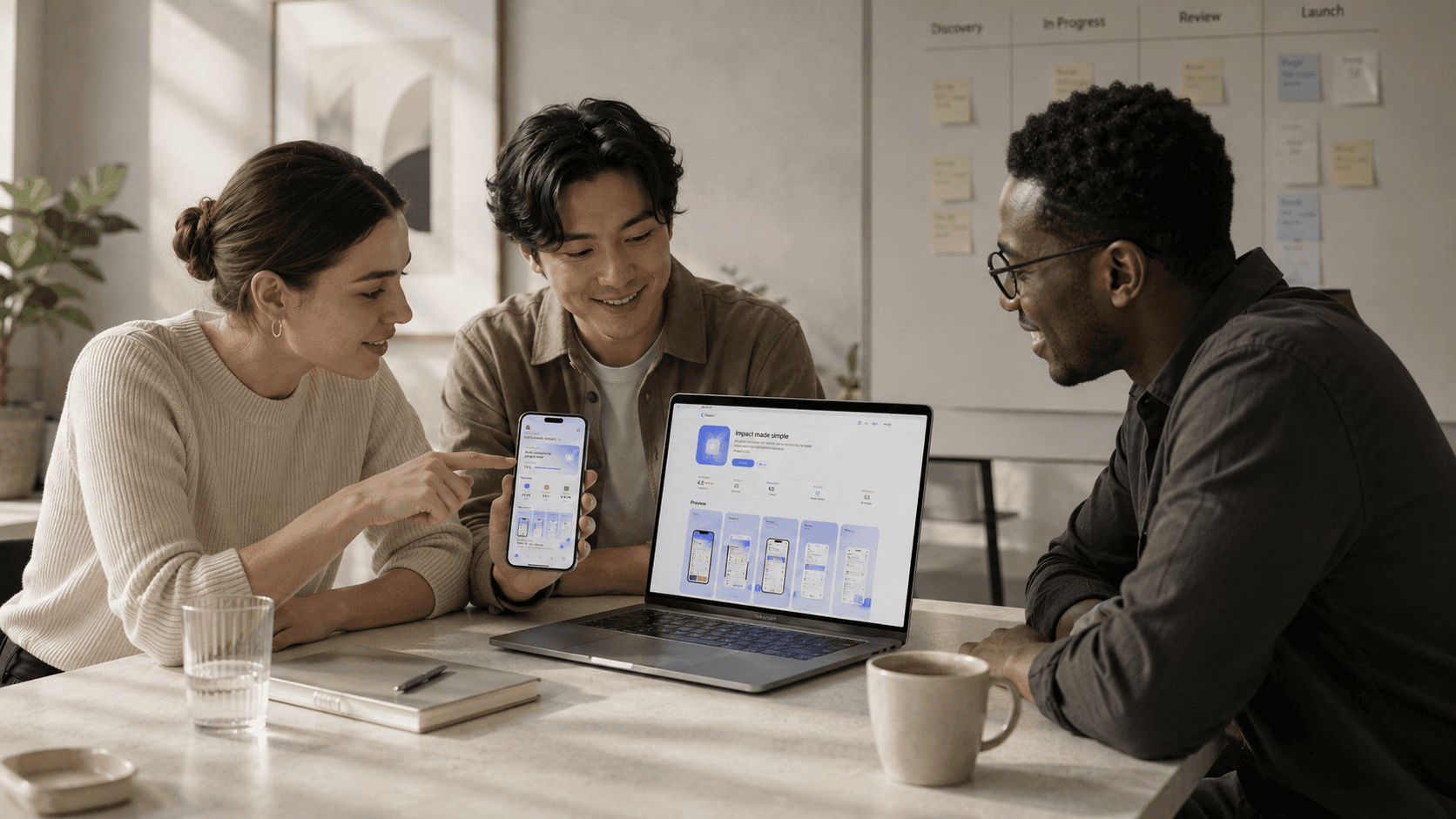
Prepare a strong launch story. Editorial teams respond to clear narratives. Who is the app for, what does it do, and why is this the right moment for it? A team that can answer those questions in three sentences has a meaningful advantage.
Keep ratings, reviews, and retention healthy. A polished launch that immediately drops to a 3.2 average rating will not be sustained as a feature. Watch the early data and respond fast.
Plan releases around meaningful product improvements. Editorial teams look at update cadence. An app that ships substantive updates regularly signals a team that is still pushing forward.
Track crashes, performance, and onboarding metrics from day one. You cannot fix what you do not measure, and editorial-quality apps are obsessive about quality data.
What Apple and Google Likely Care About
The editorial filter, distilled, is something close to this. Does the app solve a real problem in a way that is easy to understand quickly? Is the design polished enough that screenshots could live on the platform's marketing page? Does it use platform capabilities well? Is it reliable in normal use? Is it safe and privacy-conscious? Does it feel fresh, culturally relevant, or genuinely new?
A useful frame: imagine an Apple or Google editor showing your app to a colleague. What would they say? If the answer is "this is the most polished take on X I have seen this month," you are in real contention. If the answer is "it works, I guess," you are not.
Common Mistakes That Reduce the Chance of Being Featured
A few patterns consistently take otherwise promising apps out of consideration.
Rushed launches are the first. A team that ships before the app is ready leaves a trail of crashes, bad reviews, and polish gaps that editorial teams notice quickly. Poor screenshots are the second. Generic mockups, awkward crops, and unclear messaging all signal a team that didn't invest in the surface where editors look first.
Unclear positioning is another. If a reviewer cannot describe what the app does in ten seconds, they will not feature it. Bugs and crashes do the same kind of damage. So does a copycat product experience that mirrors a category leader without adding anything new.
Weak onboarding can quietly disqualify an otherwise strong app. Editors test apps the way real users do. If the first run is confusing or asks for too much too soon, the app rarely advances. Asking for featuring too late is a softer mistake. Outreach to platform contacts, when it happens, should land weeks before launch, not the day after. Treating App Store Optimization as only keywords misses the point too. ASO is also screenshots, copy, video, and overall listing quality.
TouchZen Media App Store rejection blog post
How TouchZen Media Approaches Launch-Ready Apps
Across 75+ shipped mobile apps and 12+ features from Apple and Google, the common thread is process. Featured apps are almost never the result of luck. They are the result of a team that took strategy, design, engineering, QA, and store readiness seriously from the first sprint.
At TouchZen Media, that means product strategy work up front to sharpen the value proposition, UX/UI design that holds up to editorial scrutiny, native or modern cross-platform development depending on the product, full QA and beta testing before submission, store-readiness work that treats screenshots and previews as serious deliverables, and post-launch iteration that keeps the app worthy of attention months after launch. [Internal link suggestion: link "UX/UI design" to the design / UX services page]
We do not pitch agencies as a shortcut to featuring. The honest framing is simpler: when the underlying work is done well, editorial teams notice more often. Examples of the kind of work that earns that attention can be found across the TouchZen Media portfolio.
A Final Pre-Launch Checklist for Founders
Before you submit to the App Store or Google Play, check that:
The value proposition is clear in one sentence
Onboarding gets a new user to first value in under two minutes
App startup is fast on representative devices
Crash rate is consistently below 1% in beta
Screenshots and store copy are designed, not improvised
An app preview video is in place if the product benefits from motion
Privacy disclosures, permission strings, and consent flows are clean
Basic accessibility (Dynamic Type, VoiceOver, contrast) is in place
Real users have tested the app and given honest feedback
A clear launch story is ready for press, social, and platform outreach
Retention, performance, and crash dashboards are wired up and watched
If most of these are true, your app is in real contention. If two or more are still weak, those are the next things to fix before submission.
Conclusion
Getting featured by Apple or Google is one of the most valuable moments in a mobile app's lifecycle, and there is no formula that guarantees it. What there is, consistently, is a set of qualities that featured apps almost always share: clear product value, careful design, native platform feel, real stability, and a story that an editor can tell quickly. Founders who focus their pre-launch energy on those qualities improve their chances meaningfully. Founders who focus on tricks or shortcuts do not.
At TouchZen Media, we help founders design, build, launch, and improve mobile apps that earn the kind of attention featuring requires. If you are preparing for a launch and want a partner that takes the work between MVP and editorial-quality polish seriously, reach out and we'd be glad to talk through where your app is and what the next step could look like.
Frequently Asked Questions
1. Can you guarantee that my app will be featured by Apple or Google?
No, and any team that promises this should be treated with skepticism. Featuring is an editorial decision made internally at Apple and Google. The best thing a team can do is build an app worth featuring, which materially improves the odds without ever guaranteeing the outcome.
2. What makes an app more likely to be featured?
Clear value, polished design, strong native platform feel, real stability, accessibility, privacy, well-designed store assets, and timely relevance. Editorial teams look for apps that make the platform look good. Apps that nail those qualities consistently rise to the top of internal review lists.
3. Should I contact Apple or Google before launch?
Yes, where you can. In some cases, founders may be able to share launch information through platform tools, developer relations contacts, or app store submission materials, but this should never be treated as a guaranteed path to being featured. Outreach should happen weeks before launch, not days, and should focus on what the app does and why it matters, not on asking to be featured.
4. Do App Store screenshots affect featuring potential?
Yes, significantly. Screenshots and preview videos are often the first thing an editorial reviewer sees. Generic or poorly designed assets can take an otherwise strong app out of contention. Treat the store listing as a real design project, not a final-week task.
5. How early should founders prepare for an App Store or Google Play launch?
Featuring readiness should be planned from day one, not from the last sprint. The decisions that matter—platform fit, design quality, performance, store strategy—are made across the entire build, not after it. Founders who build with featuring in mind from the start often get there. Founders who try to retrofit it rarely do.


